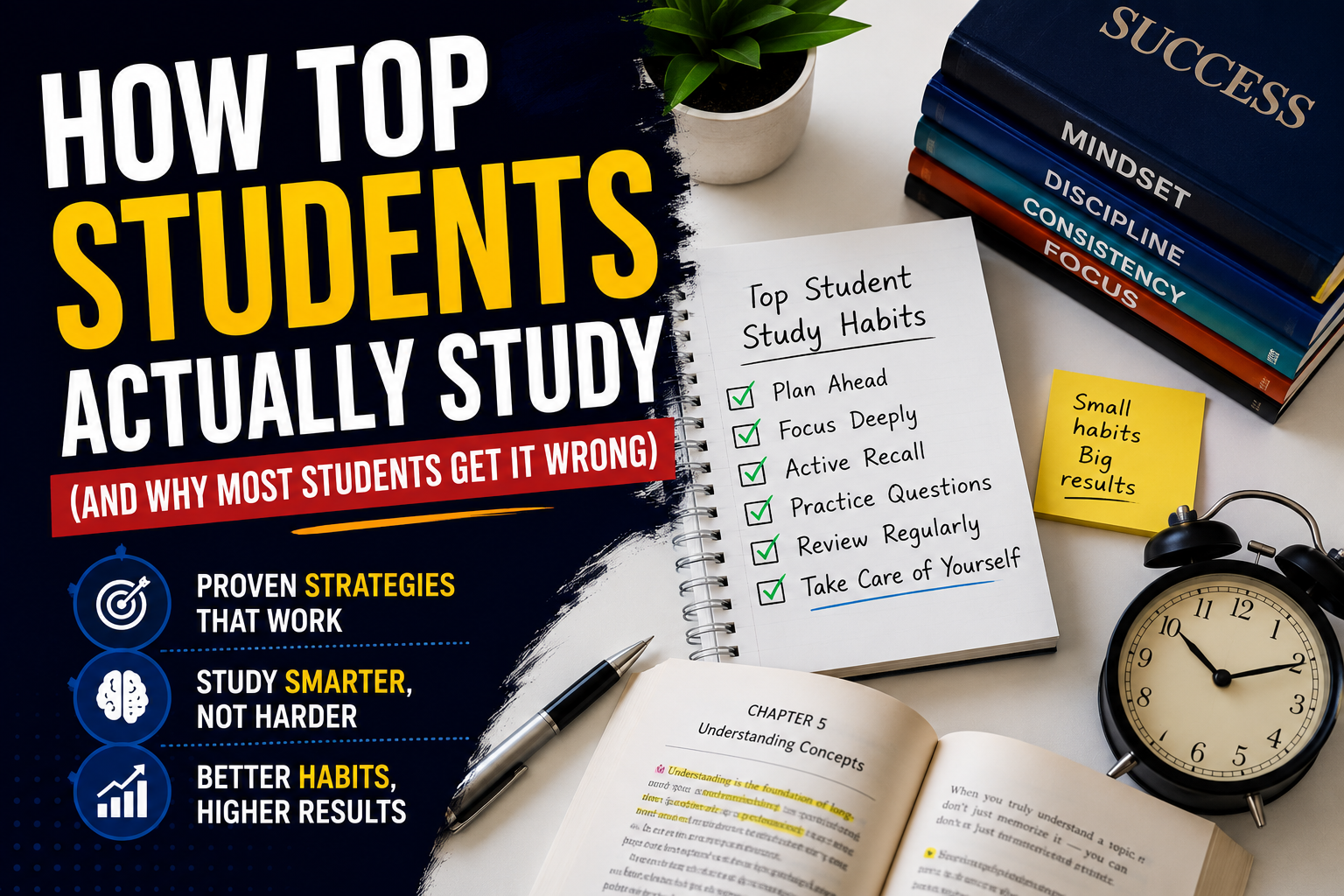
Want to know how top students consistently achieve excellent results? Discover the study habits, strategies, and mindset shifts that separate high performers from the rest.
Over the years, I have taught, mentored, and supported students from different academic backgrounds.
Some students appeared exceptionally intelligent but consistently struggled with examinations.
Others seemed average in class discussions yet repeatedly achieved excellent results.
At first, this seemed difficult to explain.
How could students with similar resources, attending the same lectures and reading the same textbooks achieve such different outcomes?
The answer became clearer with time.
The students who consistently performed well were not necessarily smarter.
They simply studied differently.
Many students assume that top-performing students spend every waking hour reading, rarely sleep, and possess extraordinary intelligence.
In reality, most high-achieving students succeed because they have developed effective learning habits.
The encouraging news is that these habits can be learned.
Let's examine how top students actually study and why many students unintentionally make learning harder than it needs to be.
The Biggest Myth About Top Students
One of the most common misconceptions in education is that academic success is determined primarily by intelligence.
While natural ability can be helpful, it is rarely the deciding factor.
In my experience, the difference between top-performing students and struggling students is often found in:
-
Study habits
-
Consistency
-
Time management
-
Self-discipline
-
Learning strategies
Top students are not necessarily studying harder.
More often, they are studying smarter.
Habit #1: They Study Consistently
Many students approach studying as an emergency response.
When examinations are approaching, they suddenly begin long study sessions and attempt to learn months of material within a few days.
Top students rarely operate this way.
Instead, they study consistently throughout the semester.
They understand that learning is a process rather than a last-minute event.
Why This Works
Regular exposure strengthens memory.
Information reviewed consistently is easier to retain than information learned through cramming.
What Most Students Get Wrong
They wait until examination pressure forces them to study.
By then, stress levels are high and learning becomes less effective.
Habit #2: They Test Themselves Frequently
One of the most effective learning strategies is self-testing.
Top students regularly challenge themselves with:
-
Practice questions
-
Flashcards
-
Past examination papers
-
Mock tests
They do not wait until examination day to discover what they know.
Why This Works
Testing strengthens memory retrieval pathways.
The more often you recall information, the easier it becomes to remember it later.
What Most Students Get Wrong
They spend most of their time reading notes rather than testing their understanding.
Reading creates familiarity.
Testing creates mastery.
Habit #3: They Focus on Understanding
Top students are curious learners.
Instead of memorizing facts blindly, they seek to understand concepts.
For example, a nursing student learning about heart failure does not simply memorize symptoms.
They ask:
-
Why do these symptoms occur?
-
What physiological changes are taking place?
-
How would this affect patient care?
Why This Works
Understanding creates meaningful connections in the brain.
Information connected to understanding is easier to recall than isolated facts.
What Most Students Get Wrong
They focus exclusively on memorization and often forget information shortly after examinations.
Habit #4: They Start Early
Top students understand the value of preparation.
They do not wait for motivation to appear.
They begin before they feel ready.
When assignments are given, they start planning.
When examination dates are announced, they begin preparing.
Why This Works
Starting early reduces stress and creates opportunities for deeper learning.
What Most Students Get Wrong
They underestimate how long preparation will take and end up rushing at the last minute.
Habit #5: They Learn From Their Mistakes
High-performing students do not view mistakes as failures.
They view mistakes as feedback.
After receiving examination results, they ask:
-
What went wrong?
-
Which questions caused difficulty?
-
What can I improve next time?
Why This Works
Growth occurs when weaknesses are identified and addressed.
What Most Students Get Wrong
Many students focus only on their scores and never analyze the reasons behind poor performance.
Habit #6: They Protect Their Sleep
This habit surprises many students.
Top students often prioritize sleep more than struggling students.
They understand that memory formation, concentration, and learning depend heavily on adequate rest.
Why This Works
Sleep plays a critical role in consolidating newly learned information.
A tired brain struggles to learn effectively.
What Most Students Get Wrong
Many students sacrifice sleep to gain additional study hours, not realizing that fatigue reduces learning efficiency.
Habit #7: They Manage Distractions
Modern students face more distractions than any previous generation.
Social media notifications, messages, videos, and online entertainment compete constantly for attention.
Top students recognize this challenge and actively manage it.
Why This Works
Deep concentration improves learning speed and retention.
What Most Students Get Wrong
They attempt to study while simultaneously engaging with multiple distractions.
Multitasking often results in reduced productivity and poorer retention.
Habit #8: They Focus on Progress Rather Than Perfection
Many students delay studying because they want the perfect environment, perfect schedule, or perfect mindset.
Top students understand that progress matters more than perfection.
They start with what they have.
They improve gradually.
They remain consistent.
Why This Works
Small actions repeated consistently produce significant results over time.
What Most Students Get Wrong
They wait for ideal conditions and lose valuable learning opportunities.
Habit #9: They Take Responsibility for Their Learning
Top students do not depend entirely on lecturers, teachers, or tutors.
They take ownership of their education.
When they do not understand something, they seek answers.
When they identify weaknesses, they address them.
When they need help, they ask for it.
Why This Works
Ownership creates accountability and motivation.
What Most Students Get Wrong
Some students assume that attending lectures alone is sufficient preparation for academic success.
What Average Students Can Learn From Top Students
The encouraging reality is that most successful students are not relying on secret techniques.
They simply practice habits that support effective learning.
You do not need extraordinary intelligence to improve academically.
You need:
-
Consistency
-
Effective study methods
-
Self-testing
-
Time management
-
Focus
-
Reflection
-
Persistence
These skills can be developed by anyone willing to apply them.
Key Takeaways
Top students do not necessarily:
-
Study all day
-
Have perfect memories
-
Possess exceptional intelligence
What they do have are effective habits.
They:
-
Study consistently
-
Test themselves regularly
-
Focus on understanding
-
Start early
-
Learn from mistakes
-
Prioritize sleep
-
Manage distractions
-
Take responsibility for learning
These habits create long-term academic success.
Final Thoughts
One of the greatest lessons I have learned from working with students is that academic success is often less mysterious than it appears.
The students who consistently achieve excellent results are usually not doing extraordinary things.
They are simply doing ordinary things consistently and effectively.
If you are currently struggling academically, do not assume that success is reserved for naturally gifted students.
Many top performers started exactly where you are today.
The difference is that they learned how to study effectively and remained committed to improving their habits.
The good news is that you can do the same.
Academic success is not just about how intelligent you are.
It is also about the habits you build and the choices you make every day.
About ClinEd Learning Hub
ClinEd Learning Hub helps healthcare students and professionals achieve academic excellence, clinical competence, and career success through practical learning resources, mentorship, and professional development opportunities.
Visit clinedlearninghub.com to discover more evidence-based strategies designed to help you study smarter, perform better, and succeed with confidence.