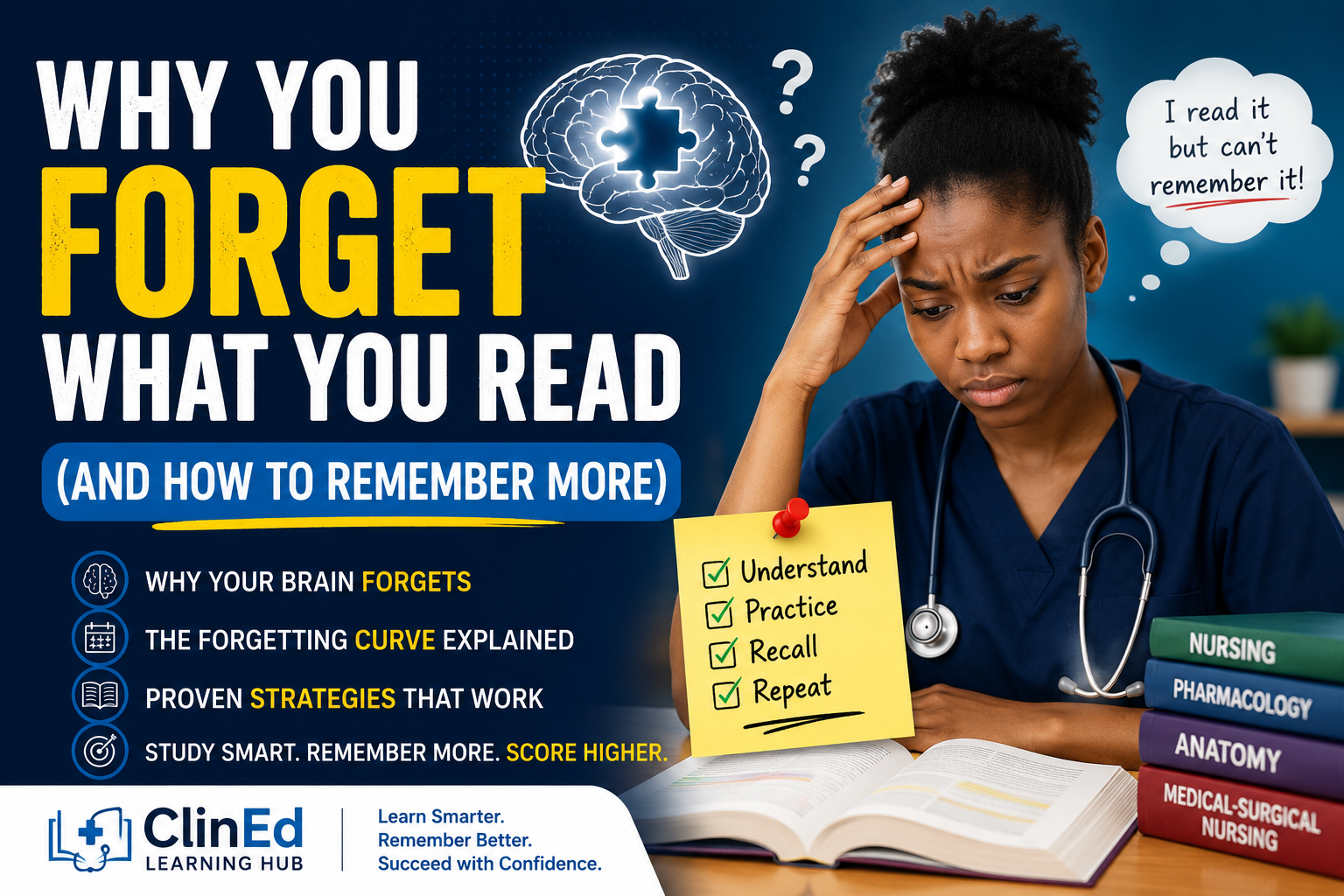
Do you often forget what you study? Learn why memory fails and discover practical techniques that can help you remember more and perform better in examinations.
I once had a conversation with a student shortly after an examination.
She appeared frustrated and disappointed.
When I asked what was wrong, her response was immediate.
"I don't understand it. I studied for weeks. I read all my notes. But when I got into the examination hall, it felt like everything disappeared from my head."
Over the years, I have heard similar statements from many students.
Some say they forget what they read within a few days.
Others complain that they remember information while studying but struggle to recall it during examinations.
The frustration is understandable.
After investing hours reading textbooks, reviewing lecture notes, and preparing for assessments, forgetting important information can feel discouraging.
The good news is that forgetting does not necessarily mean you are unintelligent.
In fact, forgetting is a normal part of how the human brain works.
The real issue is that many students unknowingly study in ways that make forgetting more likely.
Understanding why this happens is the first step toward improving memory and academic performance.
The Brain Was Not Designed to Remember Everything
Many students assume that if they read something carefully, they should automatically remember it.
Unfortunately, that is not how memory works.
Every day, your brain is exposed to enormous amounts of information.
If the brain attempted to store every detail permanently, it would quickly become overwhelmed.
Instead, the brain constantly decides:
* What information is important
* What information can be discarded
* What information should be stored for future use
This process is efficient, but it creates a challenge for students.
Unless information is reinforced, the brain often treats it as unimportant and gradually allows it to fade.
This is why reading a chapter once rarely leads to long-term retention.
The Forgetting Curve
One of the most important discoveries in learning science is known as the Forgetting Curve.
Research has shown that people forget a significant portion of newly learned information within a short period unless they actively review it.
In simple terms:
* You learn something today.
* You remember most of it immediately.
* After a few days, memory begins to decline.
* After several weeks, much of the information may be forgotten.
This explains why students often feel confident after studying but struggle to remember the material later.
The solution is not necessarily to study harder.
The solution is to review information strategically.
Why Students Forget What They Read
1. Passive Reading
One of the biggest causes of forgetting is passive reading.
Passive reading occurs when students simply move their eyes across a page without actively engaging with the content.
Many students spend hours reading chapters repeatedly while convincing themselves they are learning.
However, recognition is not the same as recall.
Just because information looks familiar does not mean you can retrieve it when needed.
How to Fix It
After reading a section:
* Close the book.
* Explain the concept in your own words.
* Write down key points from memory.
* Teach the concept to someone else.
The more actively you engage with information, the more likely you are to remember it.
2. Trying to Memorize Without Understanding
Students often attempt to memorize facts without understanding the concepts behind them.
This approach may work temporarily, but it usually leads to rapid forgetting.
For example, a nursing student may memorize the signs and symptoms of heart failure without understanding why those symptoms occur.
Without understanding, the information has no meaningful structure in memory.
How to Fix It
Focus on understanding before memorization.
Ask questions such as:
* Why does this happen?
* What causes it?
* How does it relate to other concepts?
* How would I explain it to another person?
Understanding creates stronger memory connections.
3. Studying Once and Never Revisiting the Material
Many students believe that studying a topic once is sufficient.
Unfortunately, memory does not work that way.
Learning is strengthened through repeated exposure over time.
Without review, information gradually fades.
How to Fix It
Use spaced repetition.
Review information:
* One day after learning
* Three days later
* One week later
* Two weeks later
* One month later
Each review strengthens memory and improves retention.
4. Lack of Self-Testing
Many students spend hours reading but rarely test themselves.
This is similar to an athlete preparing for a competition without ever practicing.
Self-testing forces the brain to retrieve information, which strengthens memory.
How to Fix It
Regularly use:
* Practice questions
* Flashcards
* Mock examinations
* Past examination papers
Every retrieval attempt makes future recall easier.
5. Information Overload
Trying to learn too much information at once can overwhelm the brain.
Students sometimes attempt to study multiple subjects for long hours without breaks.
As concentration decreases, retention also decreases.
How to Fix It
Break learning into manageable sessions.
Instead of studying continuously for several hours:
* Study for focused periods
* Take short breaks
* Return with a refreshed mind
Quality learning is often more effective than excessive studying.
6. Poor Sleep
Sleep plays a critical role in memory formation.
During sleep, the brain processes and strengthens newly learned information.
Students who sacrifice sleep for late-night studying often reduce their ability to retain information.
How to Fix It
Aim for adequate sleep, especially during examination periods.
A well-rested brain performs significantly better than an exhausted one.
The Four Strategies That Improve Memory
Over the years, I have found that students who remember information effectively usually apply four simple principles.
1. Active Recall
Instead of rereading notes, test yourself regularly.
Ask:
* What can I remember without looking?
* Can I explain this concept from memory?
2. Spaced Repetition
Review material multiple times over a period of weeks rather than cramming everything into a single study session.
3. Understanding Before Memorization
Seek to understand concepts deeply before attempting to memorize details.
4. Application
Apply what you learn through:
* Practice questions
* Case studies
* Discussions
* Real-life examples
The more ways you use information, the easier it becomes to remember.
What High-Performing Students Do Differently
Students who consistently perform well understand an important truth.
Learning is not about how much information enters your eyes.
Learning is about how much information remains accessible when you need it.
As a result, successful students:
* Test themselves frequently
* Review information regularly
* Focus on understanding
* Apply concepts in different situations
* Protect their sleep and well-being
These habits strengthen memory and improve academic performance.
Key Takeaways
If you frequently forget what you study, it does not mean you are incapable of learning.
More often, it means your study methods need adjustment.
Remember:
* Reading alone is not enough.
* Understanding improves memory.
* Retrieval strengthens learning.
* Regular review prevents forgetting.
* Sleep supports memory formation.
Small changes in study habits can produce remarkable improvements in retention.
Final Thoughts
One of the biggest myths in education is that people with excellent memories are simply born that way.
In reality, many successful students have learned how memory works and have adapted their study habits accordingly.
The goal is not to stop forgetting completely.
The goal is to make remembering easier.
When you understand how memory works and begin using evidence-based learning strategies, studying becomes more effective, examinations become less stressful, and academic success becomes more achievable.
The next time you find yourself forgetting what you read, remember this:
The problem may not be your memory.
The problem may be your method.
And methods can always be improved.
---
About ClinEd Learning Hub
ClinEd Learning Hub helps healthcare students and professionals achieve academic excellence, clinical competence, and career success through practical learning resources, mentorship, and professional development opportunities.
Visit clinedlearninghub.com for more evidence-based study strategies and educational resources designed to help you succeed.